
Compassion, a framework for problem-solving
A template to turn research into policy people will actually back

Compassion is not a word I would once have associated with leadership.
Like many people, I probably saw it as something admirable, even necessary, but somehow secondary, a personal virtue rather than a practical tool. Certainly not something I would have instinctively placed alongside policy, strategy, problem-solving or decision-making.
But I have changed my mind.
Compassion is the hard edge of real leadership.
We are living through an age of constant crisis. War, economic uncertainty, climate disruption, political polarisation, loneliness, declining trust in institutions, pressure on mental health, and rapid technological change are all shaping our everyday lives. Our instinctive response is usually to reach for more policy, more technology, more regulation and more data.
All of these matter. But on their own, they are not enough.
Because many of the biggest challenges we face are not simply technical problems. They are human problems. And human problems cannot be solved well unless we begin with people: their lived reality, their dignity, their fears, their needs, and their capacity to shape solutions.

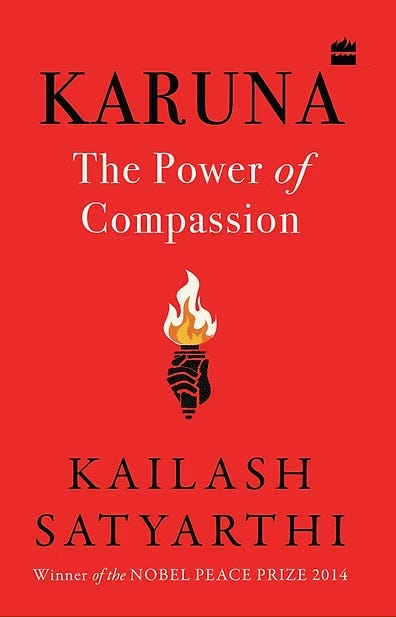
Last month, I had the opportunity to meet Kailash Satyarthi, winner of the 2014 Nobel Peace Prize, and to hear him speak about the power of compassion. I also had the chance to read his book, Karuna: The Power of Compassion. What struck me most was that he does not present compassion as sentiment, charity or softness. He presents it as a serious discipline of leadership and problem-solving.
That landed with me.
Too often, compassion is dismissed as weakness; something separate from “real” leadership. But the more I reflected on it, the more I came to see the opposite. Compassion is what gives leadership its purpose, its legitimacy and, ultimately, its effectiveness. It is what stops power becoming detached, policy becoming mechanical, and institutions losing sight of the people they exist to serve.
Compassion, properly understood, is not about feeling sorry for people. It is about seeing clearly, understanding deeply, and acting practically.
In other words, it is the hard edge of real leadership.
Compassion as a framework for problem-solving
What I found especially compelling in Kailash’s argument is that compassion is not just a feeling. It is a process.
That resonates strongly with a concept I have written about before: human security. Both start from the same place, the need to put people at the centre of how we understand and respond to challenges.
In Karuna, compassion begins with awareness: the willingness to see the problem honestly. Who is struggling? Who is being left behind? Who is carrying the burden of a policy, a system or a decision that may look fine on paper but is failing in practice?
From there comes connectedness. Data matters. Evidence matters. But numbers alone are never enough. Leaders have to go beyond the spreadsheet and understand lived experience. They have to ask not only what is happening, but what it feels like for the person living through it.
That then creates feeling not pity, and not performative empathy, but a kind of moral seriousness. A recognition that this issue matters, that it demands more than commentary, and that inaction has consequences.
And if compassion is genuine, it leads to action: thoughtful, practical steps that address not just symptoms, but causes.
That, to me, is where compassion becomes leadership.
Because leadership is not measured by how well we describe problems. It is measured by whether we solve them.
The real barrier is often hidden
One of the most valuable lessons I learned in public life is that when a proposal is blocked, rejected, delayed or dismissed, the answer is rarely just “no”.
Behind every no, there is usually a reason.
Sometimes it is cost. Sometimes it is process. Sometimes it is fear of change. Sometimes it is a legal obstacle, an institutional habit, poor communication, or simply a failure to understand the problem properly in the first place.
I firmly believe that real problem-solvers do not stop at the rejection, instead they look for the reason behind it.
That is where compassion becomes more than a moral idea. It becomes a practical tool. It helps us diagnose properly. And good diagnosis is the beginning of good leadership.
When you truly understand the human reality of a problem, and then identify the actual barrier to solving it, you move from frustration to possibility. You stop arguing with the surface and start working on the root.
That is as true in politics as it is in business, public services or community life.
Turning research into policy people will actually back
This same approach is especially relevant to one of the areas I work on every day: turning academic research into practical policy.
One of the biggest mistakes in the research-for-policy world is to assume that good research will automatically lead to good public policy. It will not. Research evidence can tell us what should work, but politics asks a harder question: what will work in the real world, with real people, and in a way the public sees as fair and credible?
That is where a more compassionate, problem-solving approach matters.
The first step is to understand not just the data, but the human reality behind it. Who is affected? Who is being left behind? What does this issue look like in everyday life for families, workers, small businesses or communities?
The next step is to connect research with lived experience. That means engaging people early, not after the policy is already drafted. In many cases, public resistance is not opposition to the goal itself. It is concern about cost, fairness, trust, complexity or unintended consequences. If we can identify the real barrier behind that resistance, we can adapt the proposal before positions harden.
That is where better policy begins.
Research gives policy credibility, but public buy-in comes from something more: clear language, visible fairness, practical delivery, and a sense that people have actually been heard. Good policy is not only evidence-informed. It is evidence translated into action in a way that people can recognise, trust and support.
A final thought
What stayed with me after reading Karuna was this: compassion is not an alternative to serious leadership. It is serious leadership.
In a world that is increasingly fast, brittle and polarised, we do not just need smarter systems or better data. We need leadership that can see the human being behind the issue, identify the real barrier to change, and build solutions that people believe in because they can see themselves within the solution. For instance, when leaders engage directly with affected communities to co-create solutions, people feel ownership and trust in the process.
Many mistake compassion for weakness. That is not softness, but instead the essential work we must undertake to create meaningful, lasting change and build solutions that people truly believe in.